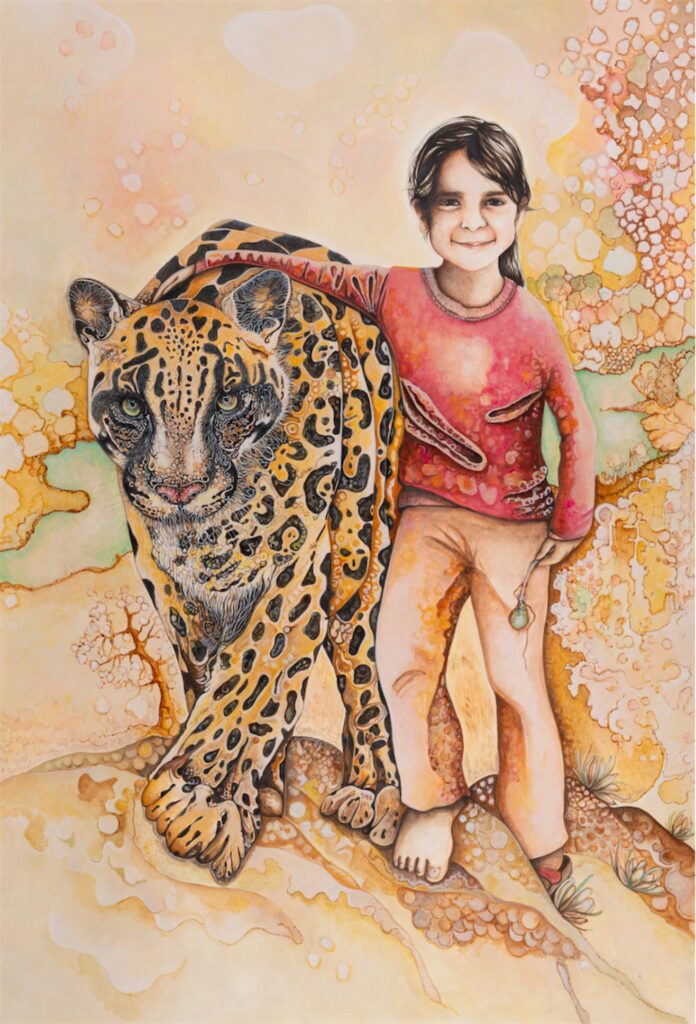

This illustration was created in memory of Narin, the child who was killed in Diyarbakır on August 21, 2024. Narin walks through the Kefrun Valley with a gentle smile and bold steps, alongside her dear friend, the Anatolian Leopard. Behind her lie the Tigris River and newly blooming spring flowers. She is wearing the clothes she had on the day she was killed; the wounds to her heart are still deep. Whereever her feet touched the ground, innocent white crocuses bloom. Spring air envelops the valley. The Anatolian Leopard has a moon-like face, as if both the sorrows and the treasures of Anatolia are etched upon its face. Smiling together, they promise each other: from now on, no child on this land will ever be left without care.
Acrylic on püre cotton rag paper 100*120, 2025
The Anatolian Leopard was first scientifically described as Felis tulliana by the French zoologist M. A. Valenciennes in 1856. It is a subspecies of the Persian leopard found in Anatolia, part of a species widespread across the Middle East and Western Asia. It has long been considered a separate species (Panthera pardus tulliana). However, modern genetic studies have shown that it differs very little from other Western and Central Asian leopards.
The Kefrun Valley is known as one of Diyarbakır’s undiscovered places. Located in the Kulp district—at the intersection of Diyarbakır, Muş, and Bingöl—which has been home to many civilizations throughout history, the Valley awaits to be explored. In the valley stands a 30-meter-high fortress, consisting of two sections, which served as a watchover during the 700-year history of the Persians (Acemler), Greeks (Rumlar), and Ottomans.